- Oncogenic signaling

Understanding the Molecular Networks Driving Cancer
Cancer development is closely linked to alterations in cellular signaling. Oncogenic signaling describes the abnormal activation or regulation of molecular pathways that control cell proliferation, survival, metabolism, differentiation, and migration.
These signaling networks connect extracellular signals with intracellular responses and gene-expression programs. Genetic mutations, receptor abnormalities, and changes in signaling proteins can transform normally regulated pathways into persistent signals that support tumor development.
Major Signaling Pathways
Several signaling pathways play central roles in cancer biology, including:
- RAS–RAF–MEK–ERK — regulates proliferation and differentiation.
- PI3K–AKT–mTOR — controls cell growth, survival, and metabolism.
- JAK–STAT — connects cytokine signaling with gene regulation.
- Wnt–β-catenin — influences cell fate, differentiation, and proliferation.
- TGF-β — regulates growth, differentiation, and tumor–microenvironment interactions.
- Notch and Hedgehog — contribute to cellular identity and developmental signaling.
These pathways do not function independently. Their interactions, feedback mechanisms, and compensatory responses create complex signaling networks within cancer cells.
Signaling and Tumor Biology
Abnormal signaling can promote several characteristics of cancer, including:
- Uncontrolled cell proliferation
- Increased cellular survival
- Metabolic reprogramming
- Resistance to cell death
- Tumor invasion and migration
- Adaptation to cellular stress
- Interaction with the tumor microenvironment
From Molecular Alterations to Functional Signaling
Identifying a mutation does not necessarily explain its biological consequences.
A genomic alteration may affect protein abundance, protein activity, phosphorylation, localization, or interactions with other molecules.
Functional studies can therefore complement molecular profiling.
Experimental approaches may include:
- Western blotting
- Phosphoprotein analysis
- Immunofluorescence
- Reporter assays
- Gene-expression analysis
- CRISPR-based perturbation
- RNA interference
- Proteomic profiling
- Drug-response experiments
- Live-cell imaging
These approaches help connect molecular alterations with measurable cellular phenotypes.

Major Oncogenic Signaling Pathways
Cancer biology involves numerous interconnected pathways. Some of the most extensively studied include the RAS–RAF–MEK–ERK pathway, PI3K–AKT–mTOR signaling, JAK–STAT signaling, Wnt–β-catenin signaling, TGF-β signaling, Notch signaling, and Hedgehog signaling.
These pathways should not be considered isolated systems.
Instead, they form interconnected signaling networks in which one pathway can influence, compensate for, or suppress another.
RAS–RAF–MEK–ERK Signaling
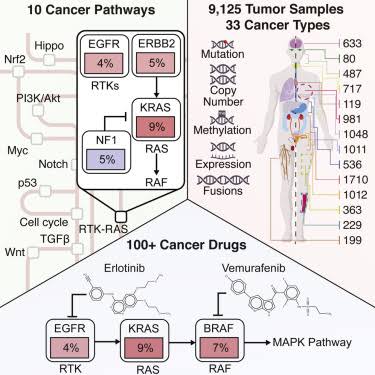
The RAS–RAF–MEK–ERK cascade is one of the central signaling systems regulating cell proliferation and differentiation.
Activation of growth-factor receptors can stimulate RAS proteins, which subsequently activate RAF kinases.
The signal is transmitted through:
RAS → RAF → MEK → ERK
Activated ERK can influence transcriptional programs associated with proliferation and cellular growth.
Alterations affecting components of this pathway can result in persistent signaling.
Oncogenic changes involving KRAS, NRAS, BRAF, and related regulators have therefore become important subjects in cancer research.
The pathway also illustrates an important principle of cancer biology: a signaling alteration can transform a normally transient cellular response into a persistent proliferative program.
PI3K–AKT–mTOR Signaling
The PI3K–AKT–mTOR network is strongly associated with cellular growth, survival, metabolism, and nutrient sensing.
Following activation of upstream receptors, PI3K generates lipid signaling molecules that contribute to AKT activation.
AKT can subsequently influence numerous cellular processes, including:
- Protein synthesis
- Glucose metabolism
- Cell survival
- Growth
- Cellular stress responses
mTOR functions as an important regulator of nutrient availability, cellular growth, and biosynthetic activity.
Dysregulation of this network can therefore affect both the survival and metabolic behavior of cancer cells.
Importantly, PI3K–AKT–mTOR signaling frequently interacts with other oncogenic pathways, making pathway-specific analysis essential for understanding tumor biology.
JAK–STAT Signaling
JAK–STAT signaling provides a direct communication route between extracellular cytokine signals and transcriptional regulation.
Activation of cytokine receptors can stimulate Janus kinases, which phosphorylate STAT proteins.
STAT proteins can then form active complexes and influence gene expression within the nucleus.
This pathway participates in:
- Immune regulation
- Inflammation
- Cell proliferation
- Differentiation
- Survival
Persistent activation of JAK–STAT signaling can contribute to abnormal cellular behavior and has been investigated across several hematological and solid tumor contexts.
Its connection with inflammatory signaling also highlights the relationship between tumor cells and the immune microenvironment.
Wnt–β-Catenin Signaling
Wnt signaling is important for developmental processes, tissue organization, stem-cell maintenance, and cellular differentiation.
A central component of this pathway is β-catenin.
Under certain conditions, Wnt signaling stabilizes β-catenin, allowing it to accumulate and influence transcriptional programs.
Aberrant Wnt–β-catenin activity can alter cellular differentiation and promote proliferative states.
This pathway is particularly important in understanding how developmental signaling mechanisms can become repurposed during tumorigenesis.
TGF-β Signaling
Transforming growth factor beta signaling has a highly context-dependent role in cancer.
In normal tissues, TGF-β signaling can contribute to growth regulation, differentiation, and tissue homeostasis.
During tumor development, however, its effects can change.
Depending on cellular context and disease stage, TGF-β-associated signaling may influence:
- Cell proliferation
- Differentiation
- Extracellular matrix remodeling
- Epithelial–mesenchymal transition
- Immune regulation
- Tumor–stroma interactions
This dual behavior demonstrates why oncogenic signaling cannot always be classified simply as "active" or "inactive."
The biological consequences of a pathway depend on cellular context, timing, molecular alterations, and interactions with other signaling systems.

Single-Cell Perspectives on Oncogenic Signaling
Bulk molecular measurements can conceal cellular heterogeneity.
A tumor may contain multiple populations with distinct genetic, transcriptional, and signaling states.
Single-cell technologies allow researchers to examine these populations individually.
Single-cell RNA sequencing can reveal transcriptional states associated with signaling activity, while other approaches can provide information about proteins, chromatin accessibility, or spatial organization.
This is particularly important because treatment resistance may arise from a small cellular population that is difficult to detect through bulk analysis.
Understanding signaling heterogeneity can therefore provide a more detailed view of tumor evolution.